
Web Development
New sites, rebuilds and ongoing changes — WordPress, Shopify, Squarespace and more. Built so you can actually update them yourself.
SEO & Search Visibility
Search is changing, but the core need remains the same: being visible where your audience is looking. We combine technical SEO fundamentals with modern optimizations for AI search—improving your Google rankings, optimizing site performance, and ensuring AI assistants can find, read, and cite your brand with confidence.
Search Engine Optimization
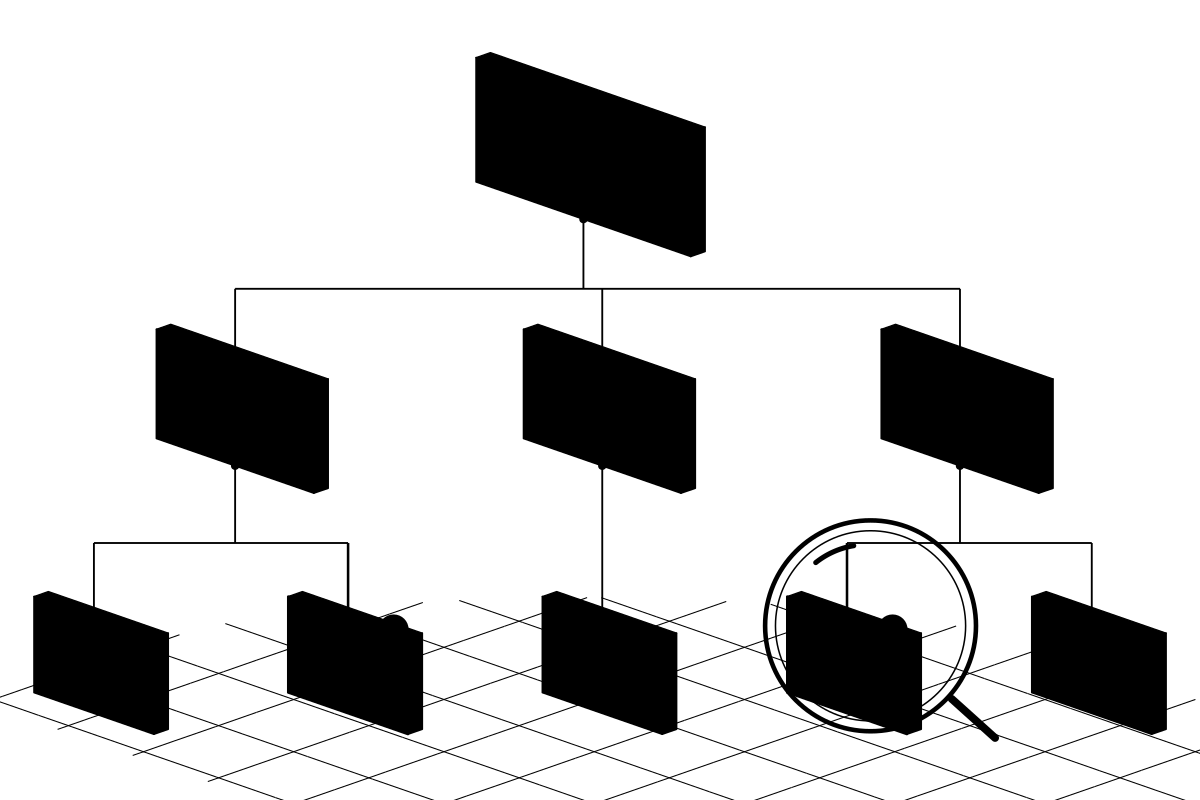
The two components of SEO: technical structure and content strategy
Having a favorable search ranking comes down to a small number of questions. The first are what we call technical SEO: can a search engine find and read every page you want it to and is your content structured in a way that makes it easy for it to understand what is important? The second area is content strategy: does the page contain unique, useful content that people are searching for? Does the rest of the internet treat you as a credible source by linking to your site?
Our SEO approach tackles both of these. First, we audit your site to ensure you have the right technical foundations in place. Then we use search data and industry competitors to highlight areas where your content could be improved and potential strategies to build viable inbound links to your site. After our initial review, we can implement the technical recommendations while you have a roadmap to longer-term content strategy.
Services
How we approach improving your search performance.
Before deciding what to change on your site, it is worth knowing what you are up against. We identify who is actually ranking for the searches that matter to you and work through what those pages are doing: how they are structured, what topics and content they cover, how quickly they load, and what other sites on the internet are linking to them. This information guides the rest of the engagement - determining relevant keywords, page and title tag considerations, and informing our content and backlink-building recommendations.
A full crawl of your site to find what is blocking search engines:
indexing and robots.txt problems, broken and chained
redirects, duplicate content, missing or duplicated title tags and meta
descriptions, thin pages, orphaned pages, broken internal links, canonical
errors and mobile usability failures. You get a written report that
prioritizes issues by impact.
Google measures the speed and loading performance of your site and uses it as a ranking input ("Google Pagespeed"). A slow site also loses visitors before they spend any time on your pages. We measure your current site performance, identify what is causing performance issues (usually images, fonts, third-party scripts or a slow host) and how to fix it. Hosting is frequently the bottleneck, which is one reason we run our own.
For a business serving a local area, local results matter more than national rankings. We set up and optimize your Google Business Profile, make sure your name, address and phone number are consistent everywhere they appear,, add location-appropriate content, and mark it all up so search engines can parse it.
Schema - or structured data - is machine readable code that makes it easy for search engines and AI crawlers to understand and index core information about your business. We implement schema.org markup that produces enhanced search listings — organization and local business details, breadcrumbs, articles, FAQs, products, events and reviews as appropriate.
We ensure Google Search Console is configured properly, there analytics are in place, and capture a baseline before we change anything so there is something to compare against. Without a baseline, nobody can tell whether the work helped.
While we are not a content agency, what we can do is tell you which pages and topics will drive additional search volume, and analyze your existing content for best practices. We also identify opportunities - industry publications, blogs, and podcasts - that will be helpful in improving your overall site reputation by generating high quality inbound links ("backlinks"). Implementing a sustainable backlink strategy takes time, but is ultimately the difference between a first page ranking and being buried in the third or fourth page of search results.
Boundaries
A short list that differentiates us from other SEO providers.
AI search
AEO, GEO, AIO — three names for the same problem.
A growing share of people now ask ChatGPT, Gemini, Perplexity or Google’s AI Overviews instead of working through a page of links. When those tools answer, they name a handful of sources. The industry has not settled on what to call optimizing for this. You will see AEO (answer engine optimization), GEO (generative engine optimization) and AIO (AI optimization) used more or less interchangeably, often by people selling it as a separate product. The fact that there is no agreed name yet tells you how new the field is.
Most of what makes an AI assistant quote you is the same work that makes a search engine rank you. These systems read the ordinary web. If your pages cannot be crawled, load slowly, contradict each other, or bury the answer six paragraphs down, a language model has the same trouble with them that Google does. However, there are specific content strategies that can increase the chance of getting cited by AI, and we will evaluate your existing content against those and provide recommendations on how to optimize.
robots.txt. It is worth
knowing which you are blocking, and deciding on purpose.
Nobody can guarantee a citation. There is no ranking report, no submission form and no paid placement. Any provider promising that you will appear in ChatGPT is guessing or worse.
Different assistants cite different sources. The overlap between them is smaller than most people assume, so treating “optimized for AI” as one finished deliverable overstates what is possible.
Be careful with llms.txt. It is a proposed
file for telling AI systems what your site contains, and it is currently
the centerpiece of a lot of AI SEO packages. Google has said publicly
that it does not use it, and only about one site in ten has one. It
costs us very little to add and we are happy to, but if someone is
charging you meaningfully for it, ask what evidence they have.
Measurement is immature. Traditional analytics cannot show you most of this, because a cited answer often produces no click at all. We will be straight with you about what we can and cannot see.
This is not a separate product with a separate invoice. It is part of the audit and the implementation work.
Pricing
A flat fee for the audit, then our standard hourly rate to fix what we find.
$850 flat
One price to complete a full assessment of your website.
$105 /hour
Fixing what the audit found, billed for actual time. Many of the highest-impact items take under an hour each. You can also implement the recommendations yourself, or we can engage in a shared effort. We will provide an estimate for resolution once the audit is complete.
Ongoing SEO support is available month to month for clients who want continued monitoring, reporting and incremental work. Because the right scope varies so much between sites, we quote it after the audit rather than publishing a number that would be wrong for most people. It is always flexible and there is no obligation.
Questions
Also available
New sites, rebuilds and ongoing changes — WordPress, Shopify, Squarespace and more. Built so you can actually update them yourself.
Updates, security monitoring and backups for your WordPress site — on whatever host you already use. From $10/month.
Fast, well-run hosting with a WordPress Care Plan included. $12.50/month, billed annually and fully refundable.
Get in touch
There is no charge for an introductory conversation. Tell us what you are trying to do and we will tell you honestly whether we are the right fit — and roughly what it should cost.